Calibration Theory
Kromacut has three complementary calibration tools. Hiding Distance measures the physical opacity of each filament. Palette Proof asks you to rank a small set of printed candidates for colors that matter to one job. Stack Matrix photographs many known physical recipes and records their observed colors. They all feed the same Auto-paint stack model, but they answer different questions.
For the step-by-step controls, saving behavior, and print-setting compatibility, see Calibration workflows. For the rest of the printing workspace, see 3D mode.
Why Thin Layers Blend
A print is viewed frontlit: light enters the top surface, passes down through the filament, reflects off what is underneath, and passes back out. A thin layer only partly hides what is below it, so the color you see is a mix of the filament's own color and the color showing through from beneath. Auto-paint uses this show-through to build in-between colors from a small filament set, which is why HD has to be accurate.
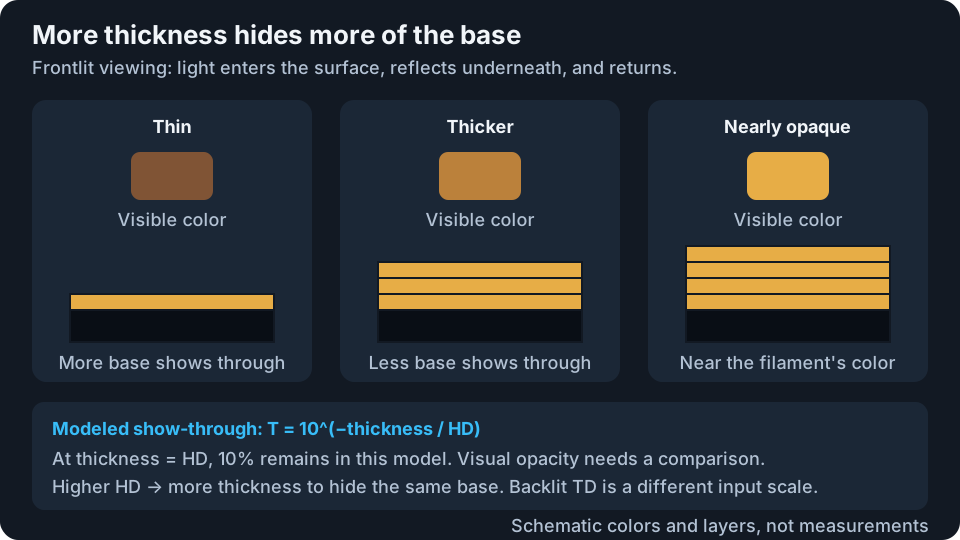
Kromacut models the show-through with a Beer-Lambert law. A thickness d of filament transmits
T = 10^(−d / HD)of the underlying color. Each added layer multiplies the show-through, so a stack reaches opacity geometrically. The rate is a material property: a dense black hides in a fraction of a millimeter, a translucent white can need ten times the depth. That rate is the hiding distance.
The Transmission Distance printed on spool sheets, or measured with backlit TD test prints, describes light passing through the filament once (lithophane-style). Frontlit viewing passes light through the layer twice and reads it against reflection, so a conventional TD is roughly 10× the hiding distance. Kromacut accepts conventional TD as input (the convert button on each filament row) but stores and simulates with HD.
The Wedge
Camera-based color measurement is unreliable: cameras auto-correct, screens differ, and lighting shifts. The wedge avoids judging any color in isolation. Each tile prints patches of 1 to N filament layers over a base, with a reference rail of the same filament at full opacity beside them and a foot marking the 1-layer end.
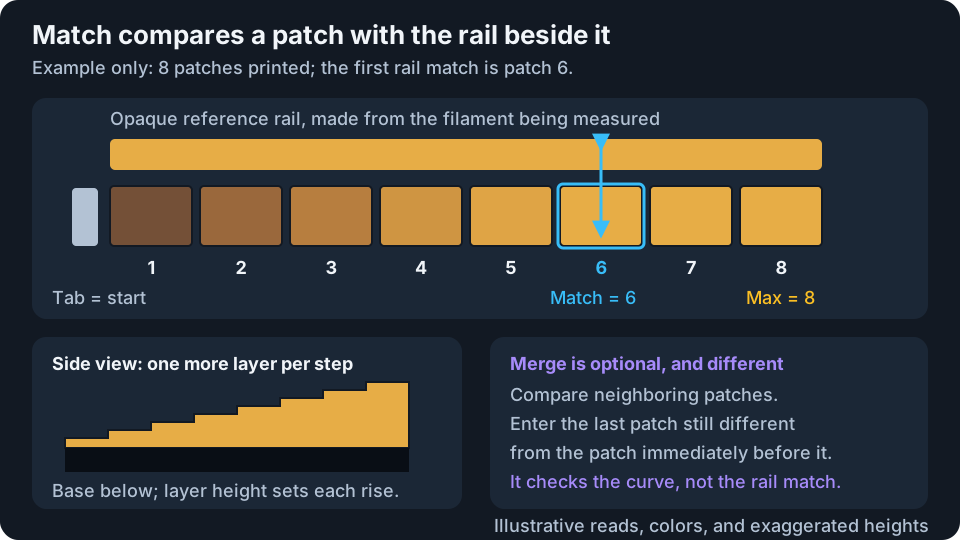
You report the first patch that looks identical to the rail beside it. The rail is the filament's own opaque color sitting millimeters away under the same light, so the comparison holds across rooms, screens, and prints. Thin patches show the base through; at some patch the difference drops below what the eye can distinguish, and that patch number is the measurement.
From a Read to a Hiding Distance
The reported patch marks the thickness at which show-through dropped below a just-noticeable difference (JND): the smallest visible color difference, about 2 ΔE00 in everyday viewing.
Kromacut solves this backward. For the filament color over the base color, it computes T*, the show-through that places the blended color exactly one JND from the opaque filament color. T* depends only on the two colors and the JND, with no hand-tuned opacity constant. The read gives the thickness at which the print reached that point, d* = patch × layer height, and Beer-Lambert inverts to:
HD = −d* / log10(T*)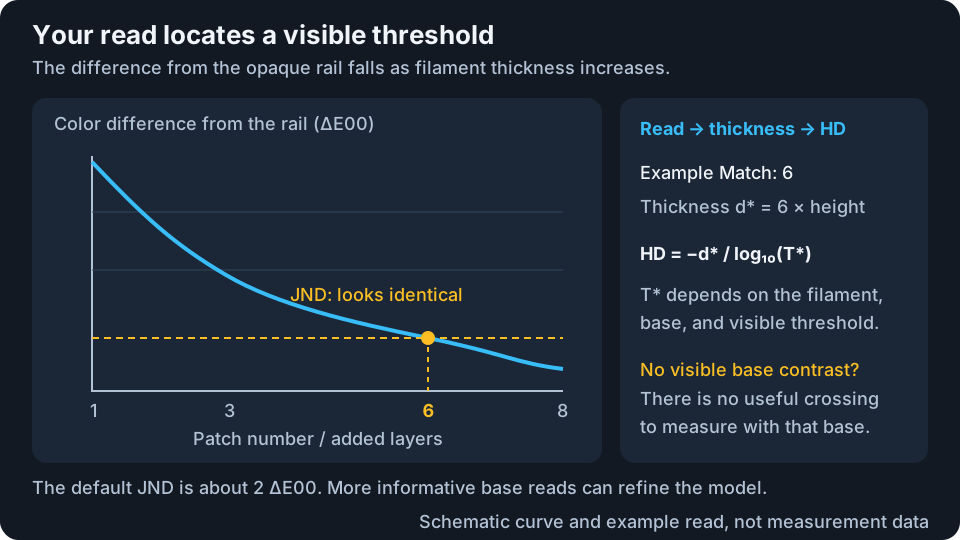
Base contrast matters here: a black filament over a black base never differs from its rail by a full JND, so there is nothing to measure. The wizard detects this and assigns dark filaments a lighter base.
Palette Proof Evidence
A Palette Proof compares real printed prefixes against colors from the current artwork. Kromacut keeps the physical layer recipe, its original HD prediction, the requested target color, and every answer. That lets one sheet provide two kinds of evidence without pretending every choice is an exact measurement.
Best available supports the selected recipe and rejects the unselected alternatives near that target, but does not force the selected patch to equal the target color. Close adds a partial local color correction. Dead on adds the strongest correction and preserves the exact tested opaque suffix as a direct anchor. Every selected patch in a tie receives support. None rejects plausible candidates near the target without inventing a correction direction.
These effects are local in both physical-recipe space and color space. Recent, optically dominant layers count most when Kromacut compares recipes; moving the same filament elsewhere in the recent stack is a weaker match. Evidence also fades as the simulated stack color or requested target moves away from the reviewed color. Several similar recipes that repeatedly lose near green targets therefore reinforce a local warning for nearby green stacks, while an unrelated red recipe is left alone.
Close and Dead-on corrections feed the same predicted Lab colors used by optimizer scoring and the final preview. Support and rejection evidence add a bounded target-aware optimizer preference, so repeated evidence can break a close numerical tie without overriding actual color error or exact anchors. The broader global lightness/chroma fit remains separate and must still pass its held-out validation gate. Local evidence and Dead-on anchors can remain useful when that global fit is gated, and all derived parameters are rebuilt deterministically from the saved raw judgments.
Stack Matrix Calibration
The Stack Matrix starts as a LUT-style measurement rather than another opacity-wedge solve. New boards sample useful recipes of different lengths up to a physical color-thickness cap, while every color-region layer retains the selected regular layer height. A 0.40 mm cap at 0.04 mm allows up to 10 color layers. The foundation is a single layer at the effective first-layer height, not a slab sized from estimated opacity. With a 0.10 mm first layer, this example is 0.50 mm tall and has 11 print layers in total.
Shorter recipes sit on extra layers of the same backing filament inside the color region, so all sample faces finish at the same Z without exceeding the cap. The extra backing is recorded separately from the useful recipe when applying measurements. A thin foundation is not guaranteed opaque: use an opaque filament and a consistent, flat photographic backing surface. The printed backing must genuinely hide the substrate before added backing can be treated as optically neutral. Older saved boards retain their original foundation thicknesses and cell map.
The possible recipe space grows exponentially, so planning uses a bounded deterministic pool of pure runs, ordered filament transitions, and longer exploratory recipes across the allowed depths. Saved HD values predict their colors. Compatible completed matrices provide measured-color coverage and a record of previously printed recipes. Selection favors color gaps and new thickness/transition coverage, with dedicated exploration informed by weak support or previous prediction errors. These acquisition scores are heuristics, not calibrated uncertainty intervals. A few intentional reference repeats support consistency checks; unprinted plans and incompatible or unaccepted photographs do not close coverage gaps.
The material-change budget includes the corner references and constrains the planner's layer-by-layer material usage. It is not a print-time or purge-volume estimate, and the slicer may add changes. A larger cap can therefore cost more even if the selected cell count stays small. New boards group similar recipes into more continuous same-color regions to reduce toolpath fragmentation; rearranging cells does not reduce the set of materials needed on each layer. Older boards retain their original fixed-depth exhaustive or HD-gamut selection and can still contribute compatible evidence without being rewritten.
The matrix prints face-up so its foundation, first-layer thickness, and following recipe layers use the same physical order as a normal Kromacut build. Four corner recipes identify orientation and define the perspective transform. After printing, photograph the face under diffuse front lighting. Kromacut estimates the board, then lets you drag four numbered marker-center handles with a magnified crosshair. An exact projected cell grid and a live rectified preview make perspective, tilt, and skew errors visible before Kromacut samples a central inset in each cell's own projective coordinates. This per-cell inset stays away from borders even when perspective makes one side of the board much narrower. Low-confidence or manually adjusted alignment requires explicit review confirmation, and that confidence and review state are saved with the measurements. Raw sampling is the conservative default. Optional reference-marker correction estimates a per-channel lighting gain from the four known marker recipes, which can reduce a color cast but can also hide a real lighting-dependent difference.
A completed matrix stores predicted and photographed sRGB colors beside the immutable physical recipes in the named filament profile. All stored compatible matrices jointly refit one effective physical model while keeping the saved swatch colors, HD calibration, and raw matrix measurements untouched. The fit treats those saved values as regularized priors, then uses every weighted matrix sample to estimate effective RGB-channel HD, effective opaque filament color, a nonlinear transmission exponent for contiguous runs of one filament, and an ordered interaction between the visible filament and the substrate below it. Sparse evidence stays on the original priors, and a fitted model is used only when there are enough samples and it improves held-out matrix ΔE without worsening its error tail. A fitted substrate interaction is used through the thickest contiguous run of that material pair observed by the matrices. Additional unmeasured thickness continues from that supported color using the substrate-appropriate wedge/HD prior toward the filament's nominal swatch; it does not switch the entire run to a different prediction or extrapolate the fitted exponent indefinitely. The same run-prefix calculation feeds candidate scoring, recipe comparisons, and the preview, including compressed and layer-snapped stacks.
The fit compares its simulated colors with the photographed sRGB values using a robust error measure, while the physical blending still happens in linear light. This gives differences in dark channels enough weight to influence the fit. The prior penalties are averaged by parameter family over the materials actually represented in the training samples; adding unused spools does not weaken or disable the same fit. Validation still determines whether the fitted model is used. Better agreement on familiar recipes does not establish accuracy for previously unmeasured filament pairs.
The compatible matrices also remain scattered empirical LUTs in predicted Lab and physical recipe space, so a newer sparse board does not erase recipes measured by an earlier board. Kromacut weights each board by reviewed alignment confidence, measured recipe coverage, recency, and robust agreement with recipes measured by at least two other boards. With only one or two observations of a recipe, agreement remains neutral because there is not enough evidence to identify an outlier. An exact fixed-depth layer recipe combines its photographed Lab observations directly. A missing recipe combines deterministic inverse-distance interpolations of nearby photographed Lab values, with physical layer order weighted toward the optically dominant top layers. Interpolation is allowed only inside each matrix's local predicted-Lab coverage and a bounded recipe neighborhood; otherwise the jointly fitted physical model is used. Outside compatible matrix evidence, that model falls back to the saved Beer-Lambert/HD priors. Both optimizer scoring and the final preview share the same prediction. Dead-on Palette Proof anchors still take priority over matrix evidence, and matrix cells are observations rather than desired image targets, so printing a broad matrix does not make the optimizer chase every sampled color.
Prediction Uncertainty
Inside the Matrix's local predicted-color coverage, interpolated corrections fade smoothly back toward the physical model as their support runs out. Exact photographed recipes keep their measured colors. A matching top material alone is not enough to transfer a Matrix measurement: the full measured foundation must match, or the alternative backing must be sufficiently opaque and optically equivalent with the same immediate substrate interaction.
For an identical measured recipe, Kromacut can also estimate a transfer to a different deeper backing when the immediate substrate is the same material and the simulated final colors differ by at most 1 ΔE00. The starting foundation must meet the opacity floor from either the current fit or the saved HD prior; diagnostics record which supported its thickness. This lets an existing print retain the prior that justified its base when a later fit changes the estimated floor. The measured correction transfers with reduced confidence and is labeled interpolated, since backing equivalence is inferred from the model rather than independently measured. This exception does not enable general recipe interpolation on a different backing.
Adding more of the same terminal filament can carry a measured prefix's correction forward. Its influence is attenuated through the original physical run and fades out over at most one Matrix recipe's thickness of extra material. It is also labeled interpolated. It does not predict thinner prefixes from a later measurement, and adding a different material ends this continuation. Direct measurements and applicable Palette Proof judgments retain their priority. Diagnostic records identify the source samples and whether evidence was transferred across a backing or continued through added thickness.
Every printable prefix receives a confidence alongside its predicted Lab color. The confidence keeps four inputs visible instead of collapsing them into unexplained certainty:
- Measurement distance: predicted-color distance and physical-recipe distance to the nearest compatible measured recipe.
- Local agreement: whether nearby samples describe a consistent correction from simulated to photographed color.
- Validation error: the LUT predicts each recipe without its own empirical sample, using the same neighbor selection and support fade as runtime. This is a conditional check with the fitted optical model held fixed, not an independent end-to-end accuracy estimate. Separately, the optical fit is refitted and tested using whole held-out matrices, or grouped recipe/substrate interactions when only one matrix is available.
- Prediction method: an exact physical observation starts with more support than interpolation, a fitted estimate, or pure Beer-Lambert simulation.
The optimizer adds at most five ΔE-equivalent points for a wholly uncertain match. This is large enough for an empirically supported near-match to beat a speculative perfect-looking gray, but it remains bounded so evidence confidence cannot overwhelm major visible color error. Dead-on anchors keep their explicit priority, and Preserve color separation still judges feasibility against raw ΔE00 rather than the risk-adjusted cost. Optimizer palettes, final preview layers, and saved target mappings retain the same confidence object, preventing search and rendering from silently using different evidence assumptions.
Photo calibration is inherently sensitive to the camera, exposure, glare, white balance, and viewing light. The camera-free wedge remains the preferred way to measure material HD. Use a Stack Matrix when you want broad empirical recipe colors under a controlled setup, and use Palette Proof when you care most about a few colors in one image.
Per-Channel Hiding Distances
Filaments do not absorb red, green, and blue equally (an orange filament passes red but blocks blue), so a single scalar HD is an approximation. Kromacut blends with three per-channel hiding distances:
- One base read (Quick mode): the opacity comparison measures scalar HD. RGB-channel differences remain a conservative estimate from the filament's swatch color, anchored so the brightest channel matches that measurement.
- Additional base reads (Accurate mode): each base stresses the estimated channel curve differently. Kromacut adjusts one bounded channel-selectivity strength and the scalar only as much as the quantized patch intervals require. It does not claim that two visual thresholds independently measured three spectral HD values.
The refined curve is used directly for base materials that were actually compared in the wedge. On an untested base, Kromacut keeps the Quick estimate instead of extrapolating a strong hue shift. You may add more bases when convenient, but three or four are not required. Fully independent channel HDs, nonlinear transmission, and substrate-specific interactions are reserved for Stack Matrix evidence with held-out and thickness-support checks.
The optional merge read records the last adjacent wedge step that still looked different. It validates the fitted curve rather than adding another free parameter: a large mismatch lowers confidence and is shown in diagnostics.
The Session JND Fit
The default JND of 2 ΔE00 is a human-vision constant, but a given viewer and lighting may sit slightly off it. When a session has enough independently informative multi-base reads, Kromacut can fit one shared JND from 1 to 3. The fit is kept only when it is clearly identifiable and beats the default; quantized wedge reads are often ambiguous with scalar HD, in which case the session correctly keeps the constant.
Confidence
Each calibration carries a confidence score for how well the measurement was pinned down:
- A read at either end of the wedge (patch 1, or the last patch) lowers confidence: the true opacity point may lie outside the printed range. Print a longer wedge or a finer layer height and recalibrate.
- Multi-base reads that disagree under the best fit lower confidence, and the disagreement is noted on the calibration.
- Confidence decays after six months, as filaments age and spools change.
Uncalibrated filaments get a lower score based on how plausible their estimated HD is.
What Changes After Calibrating
Per-channel hiding distances feed both the colors auto-paint predicts for each stack and the thickness of its transition zones. Calibrating can change generated stack heights and the swap plan, not just the preview.
A calibration belongs to the material it measured: it is tied to the swatch color it was calibrated for, editing the filament's color deactivates it, and recalibrating replaces the previous measurement rather than averaging into it.